



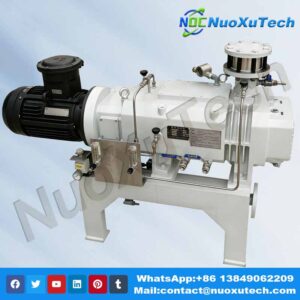

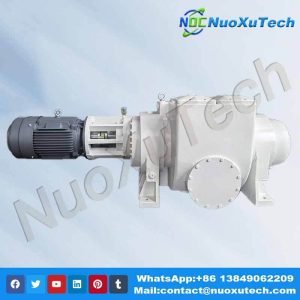
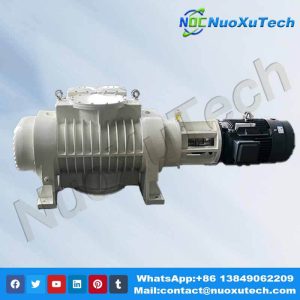
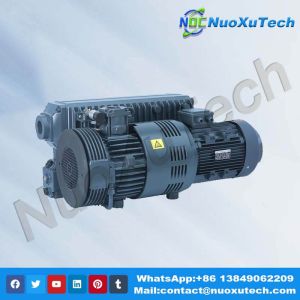
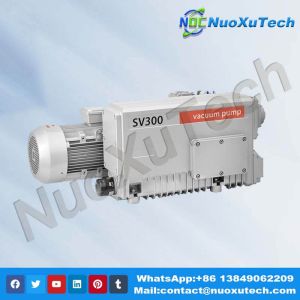
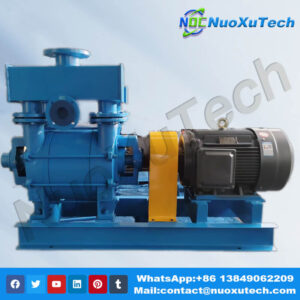

The application of liquid ring vacuum pumps (LRVPs) in atmospheric and vacuum distillation units has significantly evolved since the 1970s. Initially dominated by steam ejector systems, the integration of mechanical vacuum pumps, such as LRVPs, has become a preferred alternative in many installations. This shift is driven by the need for more reliable and efficient vacuum systems, as evidenced by successful implementations in companies like ARCO, Exxon, and Shell.
1. Working Principle of Liquid Ring Vacuum Pumps
Liquid ring vacuum pumps operate based on centrifugal force and liquid-ring sealing. When the pump’s impeller rotates, the liquid (usually water) forms a concentric ring along the inner surface of the pump casing. This ring creates crescent-shaped cavities between the impeller blades and the liquid surface.

During operation:
- Suction Phase: As the impeller rotates, the cavity size increases, creating a vacuum that draws gas into the pump.
- Compression Phase: The cavity size decreases, compressing the gas.
- Exhaust Phase: The compressed gas is expelled through the outlet.
This continuous process ensures steady suction and compression, making LRVPs ideal for industrial vacuum applications.
2. Process Flow and Control Requirements
2.1 Process Flow
An LRVP system includes a vacuum pump, motor, cooler, gas-liquid separator, and control instruments. In a typical vacuum distillation setup:
- Oil vapor from the vacuum column is drawn into the pump.
- Gas and liquid are separated in the separator; the gas is sent to the gas recovery system, and the liquid is cooled and recirculated.
- Water level and flow in the separator are maintained using level switches and control valves.
2.2 Control Requirements
To ensure stable operation:
- Outlet Pressure: Must not exceed 0.04 MPa to maintain compatibility with downstream systems.
- Vacuum Stability: Regulated via feedback control to prevent over-vacuuming, which could cause vibrations.
- Working Fluid Flow: Controlled to prevent performance drops due to low fluid levels or high temperatures.
- Seal Cooling: Adequate cooling water is supplied to mechanical seals to avoid dry running.
3. Application Scenarios

3.1 Operating Conditions
A case study at Sinopec Yanshan Refinery demonstrates the integration of LRVPs in an 8.0 Mt/a atmospheric and vacuum distillation unit.
- System Design: Three-stage vacuum system—two stages of steam ejectors and one LRVP stage, with a backup ejector for stability.
- Performance: The system maintained a stable vacuum level below 1.6 kPa (absolute), ensuring smooth operation.
Key Parameters:
- Inlet Pressure: 0.02 MPa
- Outlet Pressure: 0.12 MPa
- Circulating Water Flow: 50 t/h
3.2 Energy and Resource Consumption
- Power Consumption: LRVP motor (185 kW)
- Cooling Water: 50 t/h
- Softened Water: 0.18 t/h
4. Comparison of Vacuum Systems
A comparison between combined vacuum systems (steam ejectors + LRVPs) and traditional all-steam systems reveals significant energy savings.
| Item | Combined System | All-Steam System |
|---|---|---|
| Water Vapor Consumption | Standard | 5.63 t/h |
| Motor Power (kW) | 185 | 80 |
| Cooling Water (t/h) | 50 | 0 |
| Converted Energy (kg/t) | -0.415 | Standard |
The combined system reduced energy consumption by 0.415 kg/t, highlighting its efficiency.

5. Economic Benefits
- Investment: ¥3.6 million
- Annual Savings: ¥6.91 million in operating costs compared to all-steam systems.
- Payback Period: Less than 0.52 years.
Conclusion
Liquid ring vacuum pumps offer unparalleled advantages in terms of stability, compact structure, and energy efficiency. Their integration with steam ejectors in hybrid systems optimizes performance and minimizes costs, especially in large-scale distillation units. With significant energy savings and a rapid return on investment, LRVPs hold immense potential for future industrial applications.
Contact Us
For more information about the application of Liquid Ring Vacuum Pumps in Atmospheric and Vacuum Distillation Units, contact Nuoxutech at contact@nuoxutech.com or visit our Blogger nuoxutech.blogspot.com, You can also reach us on WhatsApp at +86 13849062209, Our team is ready to provide you with professional service and support.
Keywords
liquid ring vacuum pump use in Atmospheric and Vacuum Distillation, liquid ring vacuum pump, water ring vacuum pump use in Atmospheric and Vacuum Distillation, Atmospheric and Vacuum Distillation, atmospheric distillation, LRVP use in Atmospheric and Vacuum Distillation, vacuum system, energy efficiency, NuoXuTech
Reference:[1]Ren Jiansong, Chen Chun. Application analysis of liquid ring vacuum pump in vacuum system of atmospheric and vacuum distillation unit
[2]Chen Jian. Application of Vacuum Pump Technology by Using Liquid – ring Vacuum Pump in Large – scale CDU